Key Takeaways
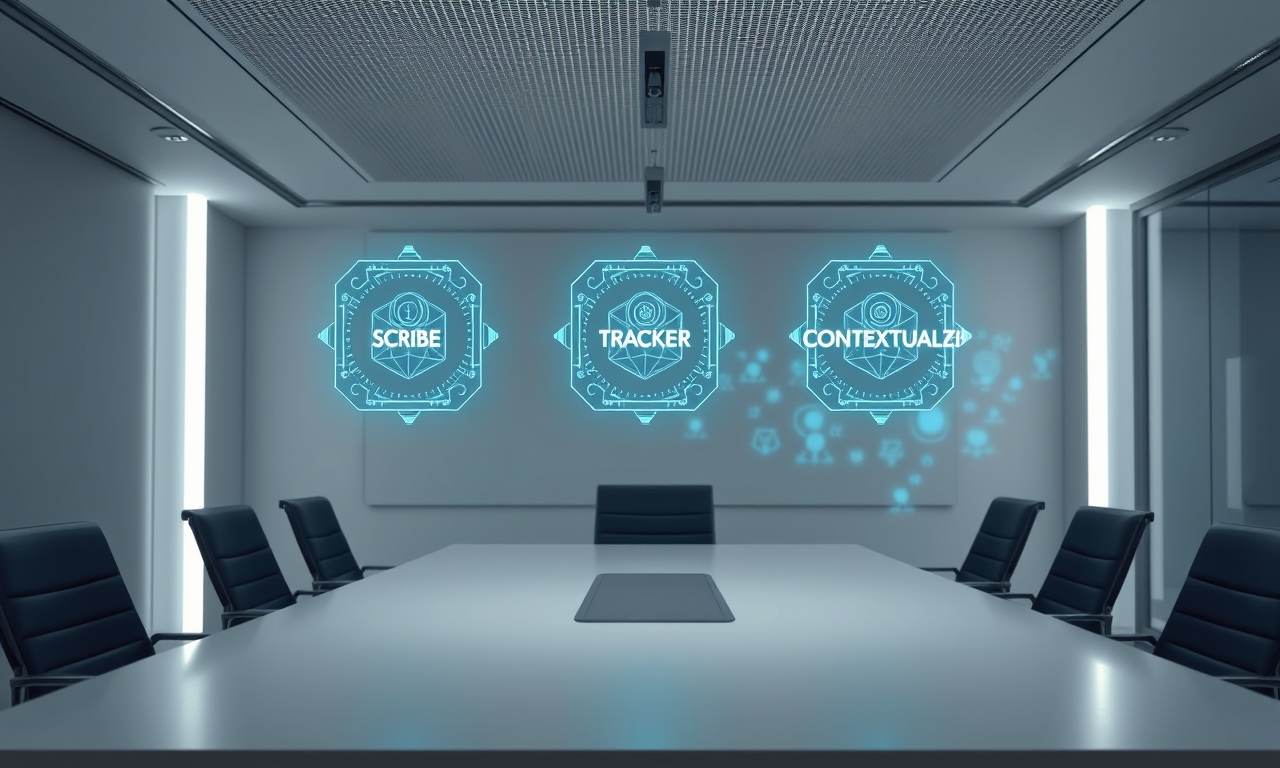
- Cap your multi-agent system at three specialized roles (Scribe, Tracker, Contextualizer) to avoid coordination overhead and agent noise.
- Structure is non-negotiable. Multi-agent systems improve structured meetings by 41% but degrade unstructured ones by 12%.
- Measure decision throughput, not time saved. Track decision-to-action latency, follow-up email volume, and re-discussion rate.
- Configure before, not during. A 3-minute pre-meeting agent brief saves 12 minutes of post-meeting cleanup.
Table of Contents
- The False Promise of "Just Add More Agents"
- The Three Roles Every Multi-Agent System Needs
- Why Unstructured Meetings Break Multi-Agent Systems
- The Decision-Rationale Gap
- Measuring What Matters
- The Setup Sequence
- The Privacy and Security Blind Spot
- When to Use Multi-Agent Meetings
- The Post-Meeting Workflow
- Common Mistakes to Avoid
- Frequently Asked Questions
The False Promise of "Just Add More Agents"
Here's the dirty secret about multi-agent meetings: most teams add AI agents hoping for linear improvement. More agents should mean more capture, more analysis, more value, right?
Wrong.
The reality is sub-linear. After three or four specialized agents, marginal returns drop to near zero. Coordination friction rises. You end up with more noise, not more signal.
I've seen teams load seven agents into a 30-minute sprint review. The result? Eight minutes spent at the end just confirming what each agent captured. That's 20% of the meeting lost to meta-work. The agents weren't saving time — they were creating a new category of overhead.
Researchers at Harvard Business Review call this the "coordination tax." Their 2025 study found that multi-agent systems introduce a 15-20% overhead from configuring, prompting, and managing AI participants. That overhead can offset the time saved in the meeting itself.
The teams that succeed treat agents as specialized participants, not general-purpose assistants. One note-taker. One action-item tracker. One data retriever. That's it.
The agent sprawl trap is real. When every agent has full access to every conversation thread, you get redundant outputs. Three agents each produce a "key decisions" list. None match. Now you're reconciling instead of acting.
The Three Roles Every Multi-Agent System Needs (And Only Three)
Let me be direct: high-performing multi-agent meetings don't use generalist agents. They use three tightly scoped roles. Anything beyond that is diminishing returns.
The Scribe
The Scribe captures verbatim notes and surface-level decisions. It handles the "what." What was discussed? What was decided? What were the key points?
This is the easiest role to implement. Most note-taking bots do this. But here's what most teams miss: the Scribe should not interpret. It should capture. Period.
The Tracker
The Tracker extracts action items, owners, and deadlines. It handles the "who and when." Who owns this task? When is it due? What's the next step?
This role requires structured output. The Tracker needs to produce items that feed directly into project management tools — Jira, Asana, Linear. If your Tracker produces a paragraph of text instead of a table of tasks, it's failing.
The Contextualizer
Here's where most systems fall apart. The Contextualizer captures the reasoning behind decisions. It handles the "why."
Why did the team choose Option A over Option B? What constraints influenced the decision? What trade-offs were discussed?
A 2026 Gartner survey on AI-augmented collaboration tools found that 66% of meeting outputs are useless to non-attendees. Why? Because they capture what was decided but not why it was decided. Teams that add a dedicated Contextualizer agent see 2.3x faster follow-through on decisions. Participants understand the reasoning, so they act without needing clarification.
The surprising data point: Teams that capture decision rationale see a 34% reduction in repeated discussions. The same topics don't get rehashed because the "why" is preserved. Someone reads the meeting output six weeks later and understands the full context, not just the bullet points.
Why Unstructured Meetings Break Multi-Agent Systems
Multi-agent systems are pattern-matching engines. They work by identifying structures — agendas, action items, decisions, timelines. When a meeting has no structure, agents produce inconsistent outputs.
I watched a product team run a brainstorming session with three agents. One agent tagged a tangent as a "key decision." Another ignored it completely. A third flagged it as a "risk item." The result was a fragmented record that required more human cleanup than a simple recording would have.
This isn't a bug. It's a fundamental limitation.
A 2025 Stanford HCI study on AI-mediated meetings quantified this precisely: multi-agent systems improve outcomes by 41% in structured meetings (agenda-driven, time-boxed, role-assigned) but degrade outcomes by 12% in unstructured brainstorming sessions. The agents' need for clear protocols clashes with creative ambiguity.
The fix is simple but hard: pre-meeting role assignments and agenda templates that agents can parse. If you're running a brainstorming session, don't use multiple agents. Use one Scribe and nothing else. If you're running a sprint planning meeting, bring the full trio.
In unstructured meetings, human participants spend an average of 6 minutes per meeting reconciling conflicting agent outputs. That's more time than they'd spend taking their own notes. The agents become a net negative.
The Decision-Rationale Gap
Most multi-agent systems are excellent at capturing transcripts. They're terrible at capturing context.
The difference matters. A transcript records "We chose Option A." But the reason — "because Option B had a 3-week delay" — is what makes the decision actionable for absent team members. Without the "why," the output is a historical record, not a decision tool.
This is the decision-rationale gap. And it's the single biggest reason multi-agent meetings fail to deliver on their promise.
Real example: A product team using multi-agent meetings saw 40% fewer follow-up clarification emails after adding decision-rationale capture. Before, team members would read the meeting notes, see "Decided to delay feature X," and immediately email the product manager asking why. After adding a Contextualizer agent that captured the reasoning — "Feature X delayed due to dependency on third-party API migration" — those emails stopped.
The Contextualizer doesn't need to be complex. It needs to capture decision trees, not just bullet points. When the team discusses a trade-off, the agent records both options and the reasoning for the chosen path. When someone raises a constraint, the agent notes it alongside the decision it influenced.
Measuring What Matters
Most teams measure meeting effectiveness by "time saved." But multi-agent systems save the wrong kind of time.
The real metrics are:
Decision-to-action latency. How long between a decision being made and the first action being taken? Multi-agent systems should reduce this by 50% or more. If your team still takes three days to act on decisions made in a meeting, your agents aren't working.
Follow-up email volume. Count the "what was decided in that meeting?" emails. This is a proxy for capture quality. If people are asking, your agents are failing.
Re-discussion rate. How often is the same topic raised in a subsequent meeting? This signals that the "why" wasn't captured. If your team rehashes the same decision in next week's meeting, your Contextualizer isn't doing its job.
Teams that track these three metrics see a 3x improvement in meeting ROI within six weeks. Why? Because they stop optimizing for the wrong thing (time saved) and start optimizing for decision throughput.
The Setup Sequence
The single biggest mistake teams make is configuring agents during the meeting. Assigning roles. Adjusting permissions. Clarifying what to capture. This creates a 5-10 minute overhead that erodes the time savings.
The fix: pre-meeting configuration. Assign agent roles before the meeting starts. Set capture scope. Define output format.
I call this the "agent brief" — a 2-minute pre-meeting document that tells each agent what to focus on. The Scribe gets a note: "Capture all decisions, ignore side conversations." The Tracker gets: "Extract action items with owners and deadlines only." The Contextualizer gets: "Record reasoning for each decision, note trade-offs discussed."
Teams that spend 3 minutes on pre-meeting agent configuration save 12 minutes per meeting in post-meeting cleanup. That's a 4:1 ROI on setup time.
The Privacy and Security Blind Spot
Here's something most teams don't think about: multi-agent systems don't just capture what you say. They capture tone, sentiment, hesitation, and off-topic remarks.
If you haven't configured data retention and access controls per agent, you're leaking decision-making context to every agent in the room.
The sentiment capture risk. Agents that analyze tone can inadvertently record emotional states. "John sounded frustrated during the budget discussion." That's a liability, not a feature.
Agent-level data permissions. Not every agent needs access to every conversation thread. Your Scribe needs full access. Your Tracker needs access to action items only. Your Contextualizer needs access to decision points but not side conversations.
A 2026 Gartner report on privacy risks in multi-agent collaboration tools found that 43% of teams using multi-agent meeting platforms have no policy on which agent can access which meeting data. That means a "note-taking" agent might have the same access as a "sentiment analysis" agent. That's a compliance nightmare waiting to happen.
For regulated industries — finance, healthcare, legal — this is critical. If your agents capture protected information without proper controls, you're exposing your organization to regulatory risk.
When to Use Multi-Agent Meetings — And When to Use a Single Agent (Or None)
Multi-agent systems are not universally better. They excel in high-stakes, decision-heavy meetings with clear agendas. Sprint planning. Budget reviews. Strategy sessions.
They underperform in one-on-ones, brainstorming, and check-ins.
The decision matrix:
| Meeting Type | Agent Count | Agent Roles |
|---|---|---|
| Sprint planning | 3 | Scribe, Tracker, Contextualizer |
| Budget review | 3 | Scribe, Tracker, Contextualizer |
| Strategy session | 2 | Scribe, Contextualizer |
| Brainstorming | 1 | Scribe only |
| One-on-one | 0 | None |
| Status check-in | 0 | None |
Teams that use multi-agent systems for every meeting see a 22% drop in meeting satisfaction scores. The overhead of agent management outweighs the benefit in low-stakes meetings.
Audit your meeting types. Assign the right agent configuration for each. Don't default to "more agents = better."
The Post-Meeting Workflow
The real value of multi-agent meetings isn't the meeting itself. It's the structured output that feeds into project management tools, decision logs, and async communication channels.
If your agents produce outputs that sit in a folder, you've wasted the investment.
Automated action item creation. The Tracker should push tasks directly into Jira, Asana, or Linear. No manual entry. No copy-paste.
Decision log generation. The Contextualizer should produce a decision log that's accessible to absent team members. Not a transcript. A structured document that shows what was decided, why, and who owns the next steps.
The meeting artifact as a living document. Don't treat meeting outputs as static records. They should be updated as decisions evolve. The Contextualizer output from last week's meeting should link to this week's progress.
Teams that automate post-meeting output delivery — agents push to Slack, Notion, or PM tools — see 2.7x higher adoption of meeting outputs. The outputs arrive where work happens, not in a separate meeting notes app.
Common Mistakes to Avoid
1. Treating all agents as equal participants
Giving every agent full access to conversation data creates privacy risks and output redundancy. Assign role-specific permissions and capture scope. Your Scribe doesn't need sentiment analysis access. Your Contextualizer doesn't need to capture every side comment.
2. Using multi-agent systems for every meeting type
One-on-ones, brainstorming, and status check-ins don't benefit from multiple agents. The overhead of agent management outweighs the benefit. Use a single agent or none for low-stakes meetings.
3. Ignoring the "why" in favor of the "what"
Most multi-agent systems capture decisions but not decision rationale. Teams that add a Contextualizer agent see 2.3x faster follow-through because participants understand the reasoning. Don't settle for transcripts. Capture the context.
Frequently Asked Questions
How many AI agents should I use in a typical team meeting?
Three. A Scribe for capture, a Tracker for action items, and a Contextualizer for decision rationale. More than three creates coordination overhead that offsets the time savings.
Can multi-agent systems work for remote teams with asynchronous communication?
Yes, but with caveats. Multi-agent systems work best for synchronous meetings. For async communication, use a single agent that summarizes threads and extracts action items. Multiple agents in async channels create noise.
What's the difference between a multi-agent meeting platform and a simple AI note-taker?
A simple note-taker captures what was said. A multi-agent platform captures what was said, who owns the next steps, and why decisions were made. The difference is the Contextualizer role — the "why" that makes outputs actionable.
How do I prevent AI agents from capturing sensitive or off-topic information?
Configure agent-level data permissions. Set capture scope before the meeting. Define what each agent should ignore. Use pre-meeting briefs to tell agents what to focus on and what to skip.
Do multi-agent meetings require all participants to use the same platform?
No. Multi-agent systems can work with any meeting platform that supports recording or transcription. The agents process the audio or transcript, not the platform itself.
Further Reading
- AiMeetOS product page — See how structured meeting templates and pre-configured agent roles work in practice.
- Lumorabuild's approach to digital product development — Understand the philosophy of building tools that respect human attention.
- Harvard Business Review (2025) — "The Coordination Tax in Multi-Agent Collaboration Systems" (search for the full study).
Ready to stop wasting meeting time on agent management?
The teams that win with multi-agent meetings don't add more agents. They add the right agents, configured before the meeting starts, with clear roles and output formats.
Try AiMeetOS and see how three specialized agents can transform your meeting outcomes — without the overhead of agent sprawl.